
Follow Up Email After No Response: A How-To Guide
Learn when and how to send a follow up email after no response. Our guide provides proven templates, timing strategies, and tips to get replies.
You send a thoughtful email. You proofread it twice. You hit send, wait, refresh, and get nothing.
That silence is where many either give up too early or start writing awkward “just checking in” messages that make things worse. A good follow up email after no response does neither. It treats silence as normal, respects the other person’s time, and gives them a simple reason to reply.
The practical shift is this. Stop treating follow-up as a reminder that you exist. Treat it as a continuation of the conversation you wanted to start in the first place.
Why Your First Email Is Just the Beginning
A lot of strong outreach dies because the sender assumes no reply means no interest. In real inboxes, that’s rarely the full story. People skim, get pulled into meetings, open an email on mobile, mean to reply later, then lose the thread.
That’s why the first email should be viewed as your opening move, not your full shot. Yesware found that 70% of all sales email chains stop after the first attempt, which means most opportunities disappear because nobody followed up at all. If you want better results from cold outreach, that statistic alone should change your behavior.
The best senders build follow-up into the original plan. They don’t improvise after silence. They expect silence, then respond to it professionally.
Practical rule: Silence after one email is usually an inbox problem, a timing problem, or a priority problem. It isn’t automatically a rejection.
That mindset matters because it changes your tone. When you stop assuming the prospect is ignoring you on purpose, your follow-up gets shorter, calmer, and more useful.
If you want to sharpen the email that starts the chain in the first place, these effective cold outreach techniques are worth studying. And if you’re trying to understand whether your messages are being seen at all, this guide to email open rate basics helps frame what engagement signals can and can’t tell you.
Persistence beats one-shot outreach
A strong follow-up sequence does three things:
- Resurfaces the thread: Your original email returns to the top of the inbox.
- Adds context: Each message gives the recipient a fresh reason to care.
- Reduces friction: You make replying easier than postponing.
That’s the true goal. Not pressure. Not guilt. Just a better chance at a conversation.
The Art and Science of Follow-Up Timing
Timing makes the difference between a professional nudge and an annoying interruption. Most bad follow-ups fail because they arrive too soon, too often, or with no change in message.
For optimal response rates, send the first follow-up email exactly 3 days after the initial contact, because reply probabilities begin to decline significantly after the 5-day mark. Following up the next day can negatively impact reply rates according to Artisan’s cold email follow-up guidance.
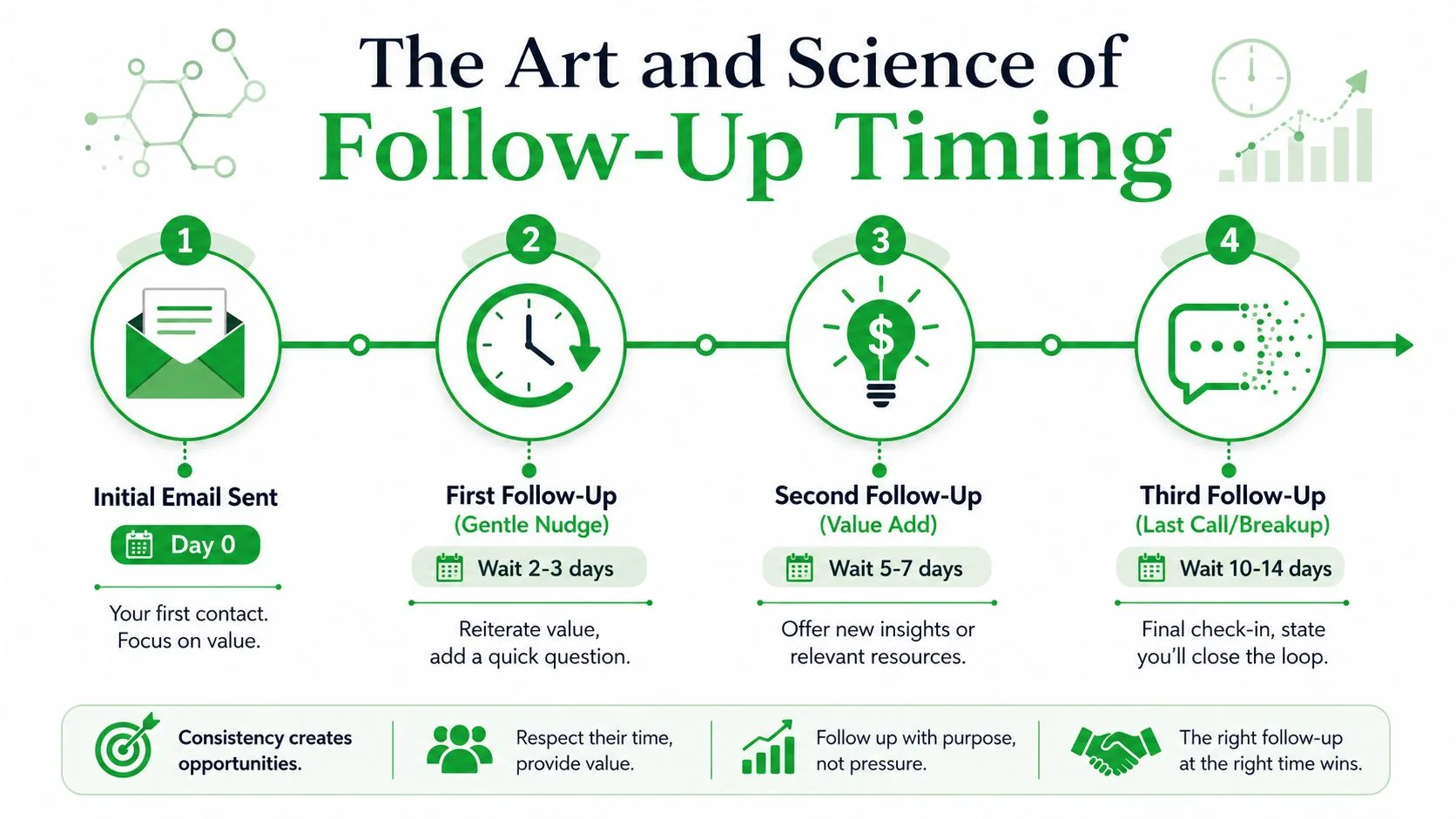
A cadence that feels persistent, not pushy
Use this simple rhythm:
-
Day 0 Send the initial email. Keep the focus tight. One problem, one value proposition, one next step.
-
Day 3 Send the first follow-up. This is a light nudge, not a rewrite of the original email. Briefly restate relevance and ask an easy question.
-
Days 6 to 8 Send the second follow-up. Add something new. A short insight, a relevant article, a quick example, or a useful resource works better than repeating your first message.
-
Days 10 to 14 Send the final follow-up. Close the loop politely. Give them a clean out and make it clear you won’t keep filling their inbox.
Why waiting works
People need time to process a cold message, especially if your email asks them to make a decision, review an offer, or consider a new vendor. A same-day or next-day follow-up often signals anxiety. It doesn’t signal value.
A few days of space does two useful things:
- It respects workload: Busy people don’t want to be chased while triaging their inbox.
- It changes the context: A later message feels like a timely reminder instead of a digital tap on the shoulder.
Don’t compress your sequence because you’re impatient. The recipient experiences that as pressure.
When to stop
A practical ceiling for most outreach is a short sequence, not endless nudges. Once you’ve made a clear offer, added a fresh angle, and sent a courteous final note, you’ve done your job.
If there’s still no response, move on. Chasing past that point usually hurts more than it helps. It drains your time and teaches you to confuse activity with progress.
Anatomy of a Follow-Up That Gets a Reply
Most follow-ups fail because they don’t earn their place in the inbox. They say “checking in” without adding anything. Good follow-ups do the opposite. They are shorter than the first email, more specific, and easier to answer.
Sending at least one follow-up email after no response nearly doubles a representative’s reply rate, lifting it from 16% to 27%. The optimal strategy involves sending 2–3 follow-up emails. That’s why the structure matters. You don’t need more words. You need better words.
Subject lines that carry the thread forward
The subject line should feel connected to the previous message. It should not sound like a trick.
Good options are simple:
- Reuse the original thread
- Mention the topic directly
- Reference the specific value you offered
Bad options try to manufacture urgency or curiosity. If your subject line sounds like a marketing stunt, people treat it like one.
Openers that acknowledge reality
The opening line should lower resistance. Don’t start with guilt. Don’t imply they owe you a reply.
Use language like:
- I wanted to follow up on the note below
- Reaching back out in case this got buried
- Sharing one additional idea that may be useful here
That wording works because it sounds human. It leaves room for the recipient to have been busy.
A follow-up should never make the recipient defend their silence.
Add a new reason to respond
This is the part often overlooked. Every follow-up should add something. Not a lot. Just enough to justify the message.
A useful follow-up can include:
- A sharper angle: Narrow the benefit to one specific problem.
- A relevant resource: Share a guide, article, or example tied to their situation.
- A quick observation: Reference a role change, hiring push, product launch, or workflow challenge if it aligns.
- A clearer option: Offer a smaller next step than a full meeting.
The key is variation. If your second and third emails are identical in substance, the recipient assumes future emails will be identical too.
Use a low-friction CTA
Your call to action should be easy to answer from a phone in under ten seconds.
Try questions like:
- Open to a quick conversation next week?
- Want me to send a brief summary instead?
- Is this something you’re the right person for?
Those work because they reduce effort. A high-friction CTA asks for too much too early. A low-friction CTA keeps the conversation moving.
Proven Follow-Up Templates for Any Scenario
Templates work best when you treat them as starting points, not scripts. The audience changes the tone, the value you add, and the CTA that makes sense. A recruiter shouldn’t sound like a salesperson. A freelancer shouldn’t sound like a customer success manager.
If you want more examples for prospecting messages, this collection on email prospecting with samples is a useful complement. For estimate and client follow-up language outside pure sales, these Pipeline On’s follow-up templates are also practical.
Follow-Up Template Quick Guide
| Audience | Follow-Up Number | Subject Line Example | Core Message Focus |
|---|---|---|---|
| Sales prospect | First | Re: reducing manual reporting | Gentle reminder and one clear question |
| Sales prospect | Second | One idea for your reporting workflow | Fresh value and a smaller CTA |
| Sales prospect | Final | Should I close the loop | Polite exit and permission to opt out |
| Recruiter candidate | First | Re: role at [Company] | Quick nudge and timing check |
| Recruiter candidate | Second | More detail on the role | Add context that helps decision-making |
| Freelancer lead | First | Re: website copy support | Reminder tied to the client’s stated goal |
| Freelancer lead | Final | Happy to revisit later | Leave the door open without pressure |
Sales follow-up sequence
First follow-up
Subject: Re: improving demo follow-through
Hi [Name],
Following up on the note below in case it got buried.
I thought the idea might be relevant because your team seems to be handling a high volume of inbound conversations, and follow-through usually breaks down when reps are juggling too many threads at once.
Open to a brief chat next week?
Best, [Your Name]
Second follow-up
Subject: one idea for your demo process
Hi [Name],
One additional thought.
If the challenge is response lag after demos, I can send over a short breakdown of the follow-up structure we use to keep conversations moving without sounding repetitive.
Would that be useful?
Best, [Your Name]
Final follow-up
Subject: should I close the loop
Hi [Name],
I haven’t heard back, so I’ll assume this isn’t a priority right now.
If that changes later, feel free to reply and I can send the summary or set up a short call.
Best, [Your Name]
Recruiter follow-up
Recruiting follow-ups work when they reduce uncertainty.
Hi [Name],
Wanted to follow up on the role I sent over. I know these messages can land at a busy time.
If you’d like, I can send a shorter overview covering the team, scope, and interview process so you can decide quickly whether it’s worth exploring.
Best, [Your Name]
Freelancer follow-up
Freelancers should reconnect to the client’s project, not to their own need for work.
Hi [Name],
Following up on my earlier note about supporting the launch copy for your new site.
You mentioned needing messaging that’s clearer for first-time visitors. If helpful, I can send a short sample outline showing how I’d structure the homepage before we discuss a full project.
Interested?
Best, [Your Name]
Using Mail Tracker for Gmail to Perfect Your Follow-Up
The hardest part of follow-up is usually uncertainty. You don’t know whether the message was seen, skimmed, or never surfaced in the inbox at all. That uncertainty pushes people into bad habits. They follow up too early, too vaguely, or too often.
The useful shift is becoming open-aware. Instead of sending the same “did you see this?” nudge to everyone, you adjust based on the engagement signal you have. That changes both timing and wording.
According to this analysis of open-aware follow-ups, HubSpot’s 2025 State of Sales Report indicates that 68% of sales emails are opened but 92% go unanswered. High-performing teams are seeing a 45% increase in open-aware follow-ups that acknowledge this engagement, moving the conversation from “Did you see this?” to “What were your thoughts?”
What open-aware follow-up actually means
If you know an email was opened, your next message shouldn’t pretend the person never saw it. That’s the subtle mistake most generic follow-up advice makes.
A better open-aware approach looks like this:
- Opened once, no reply: Send a normal follow-up on your planned cadence, but tighten the value.
- Opened multiple times: Assume interest or internal discussion. Your next note should answer an objection, add proof, or simplify the next step.
- No reliable engagement signal: Keep the message broad and useful. Don’t over-interpret silence.
There’s an important trade-off here. Open data can improve timing, but it isn’t perfect. Email open tracking relies on invisible pixels, and open tracking can be unreliable because of blocked pixels, security bots, and privacy protections. Use opens as directional input, not as courtroom evidence.
Turning insight into action inside Gmail
When tracking is built directly into Gmail, it becomes easier to work from the inbox you already use instead of bouncing between tools. For users who want a practical walkthrough, these expert tips for effective Mailtrack usage show how to interpret read receipts and alerts without overreacting to them.
A key operational benefit is speed. If you receive a real-time notification that a prospect opened your message, you can follow up while your email is still fresh in their attention window instead of sending a guess-based reminder days later.
This video shows how that workflow fits into Gmail.
The product name matters
One quick clarification because the wording is easy to blur. Mail Tracker for Gmail is the product name. That’s different from the generic category people often describe as a mail tracker for Gmail or an email tracker for Gmail.
That distinction matters when you’re comparing tools. A category tells you what kind of software it is. A product tells you which tool you’re using inside Gmail.
Common Follow-Up Mistakes That Kill Your Reply Rate
Poor reply rates are often attributed to weak offers. Often the offer is fine. The follow-up is what breaks trust.
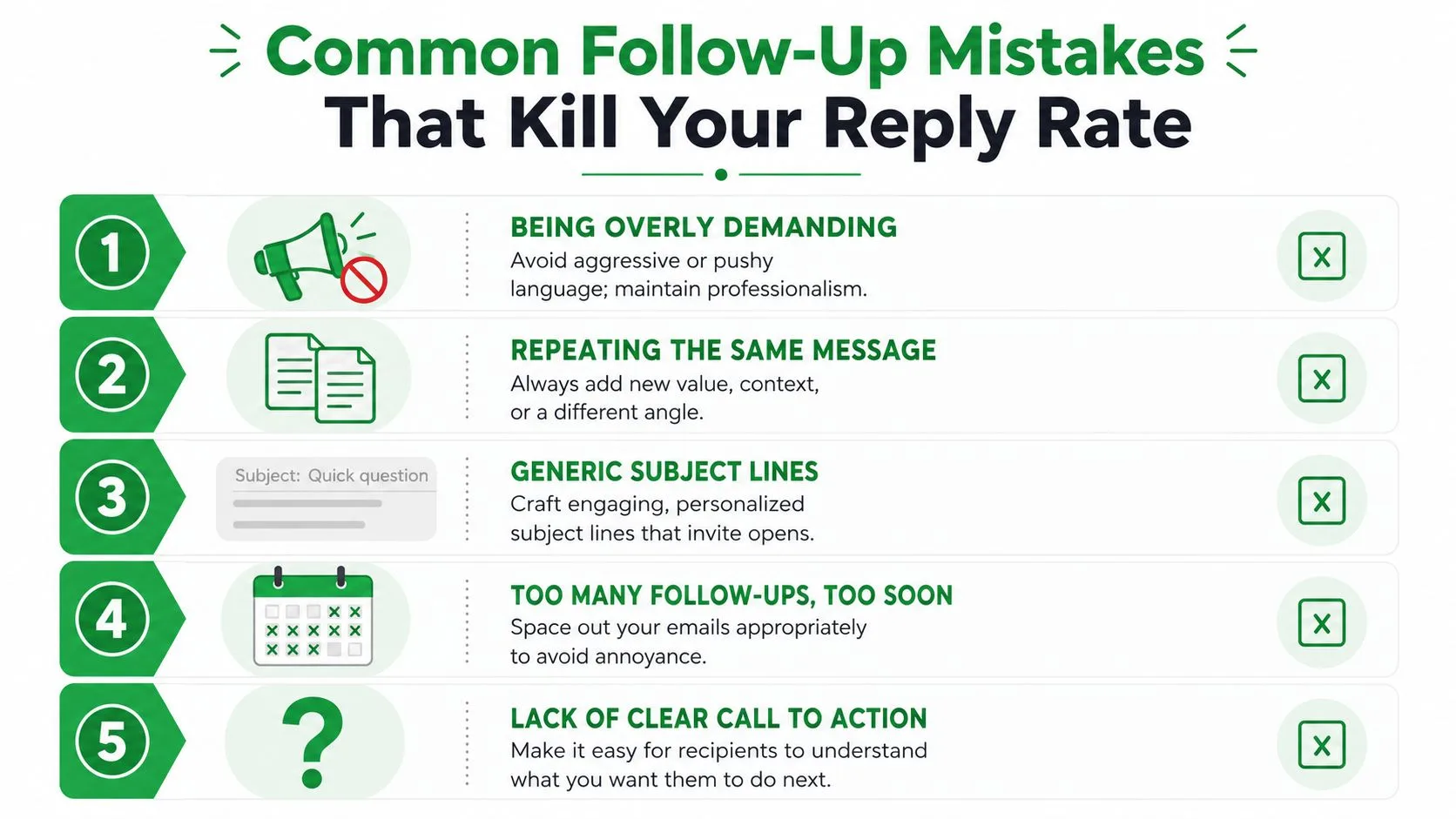
According to LeadSquared’s follow-up email guidance, passive-aggressive tone and identical phrasing can reduce response rates by 25–30%. Failing to personalize messages or optimize for mobile viewing results in a 35% lower response rate.
The mistakes that hurt most
- Sounding annoyed: “Just circling back again” and “I haven’t heard from you” can read as blame, even when you don’t mean it that way.
- Resending the same message: If your follow-up is a copy of your first email, you’ve added inbox volume without adding value.
- Writing for desktop only: Long paragraphs look manageable on a laptop and exhausting on a phone.
- Using vague CTAs: “Let me know your thoughts” is polite but weak. Ask for one specific next step.
- Over-personalizing the wrong way: Mentioning irrelevant details you scraped online can feel more invasive than thoughtful.
A better last check before sending
Ask yourself five quick questions:
- Is this shorter than the original email?
- Does it add anything new?
- Could someone reply from a phone in one line?
- Does the tone sound calm, not frustrated?
- Am I following up because it helps the recipient decide, or because I’m uncomfortable with silence?
Strong follow-up feels easy to answer. Weak follow-up feels like homework.
If you’re working specifically on nonresponsive prospect threads, this guide on how to get sales leads to respond is a useful outside perspective on diagnosing where outreach breaks down.
If you want better timing, clearer read signals, and less guesswork in Gmail, Mail Tracker for Gmail is built for exactly that. It adds read receipts, double check marks, and real-time open notifications directly inside Gmail so you can send smarter follow-ups without changing your workflow.
Ready to track your emails?
Add Mail Track for Gmail from the Google Workspace Marketplace and know the moment your emails are opened. Free and unlimited.
Add to Gmail