
Objection in Sales Explained and How to Handle It
Learn what objection in sales really means, why it happens, and proven frameworks to handle price, timing and trust objections with confidence.
You send a solid outreach email. The prospect opens it. Then nothing happens.
A day later, you call. They say, “We’re not interested right now,” or “Send me something and we’ll take a look.” The air goes out of the conversation. Many reps hear that moment as a rejection. Stronger reps hear it as a clue.
That shift matters because an objection in sales usually isn’t the end of the deal. It’s the buyer telling you where the friction is. Maybe the timing is off. Maybe they don’t see the value yet. Maybe they need another stakeholder involved. Maybe they saw your email three times and still couldn’t decide what to do next.
If you treat every objection like a wall, you’ll push harder, talk faster, and miss the issue. If you treat it like a diagnostic signal, the conversation becomes simpler. First classify the objection. Then answer the friction behind it.
Introduction Why Objections Are Part of Selling
You’ve probably lived this call.
The opener worked. The prospect sounded engaged. You asked a good question, they described a pain point, and for a minute it felt like the conversation was moving. Then you heard, “This isn’t a priority right now.”
At that moment, most reps do one of two things. They either defend the pitch too early, or they retreat and end the call. Both reactions come from the same assumption: an objection means the opportunity is fading.
That assumption is usually wrong.
Large-scale call analysis found that 39% of objections could be overturned when handled well, with 46% of “No Immediate Need” objections and 46% of “Lack of Time” objections successfully handled. Even “Not Interested,” which appeared more than 150,000 times, was still overcome 23% of the time according to MaxContact’s summary of published sales call research.

Those numbers don’t mean every objection is winnable. They mean the objection itself isn’t the verdict. The response, the timing, and the diagnosis all matter.
What top reps hear differently
A newer rep hears, “Too expensive,” and thinks, “I need a better price response.”
A more experienced rep hears, “Too expensive,” and thinks, “Do they mean budget, value, risk, or internal approval?” Same words. Different interpretation.
Practical rule: The first sentence a buyer says is often the label of the objection, not the cause of it.
That’s why a classification-first approach works so well. Instead of memorizing dozens of rebuttals, you sort the pushback into a small set of common patterns. Then you match your response to the actual buying friction.
What gets easier when you think this way
Once you stop treating objections as personal rejection, your tone changes. You ask cleaner questions. You don’t rush to fill silence. You stop trying to “win” the exchange and start trying to understand it.
That’s the heart of objection handling. Not verbal sparring. Not clever comebacks. Clear diagnosis.
What an Objection in Sales Really Means
A buyer says, “Send me something.” Another says, “This feels expensive.” A third says, “We can’t buy until legal approves security review.”
Those sound similar if you are new to sales. They are all forms of resistance. But they are not the same kind of resistance, and treating them the same creates bad decisions.
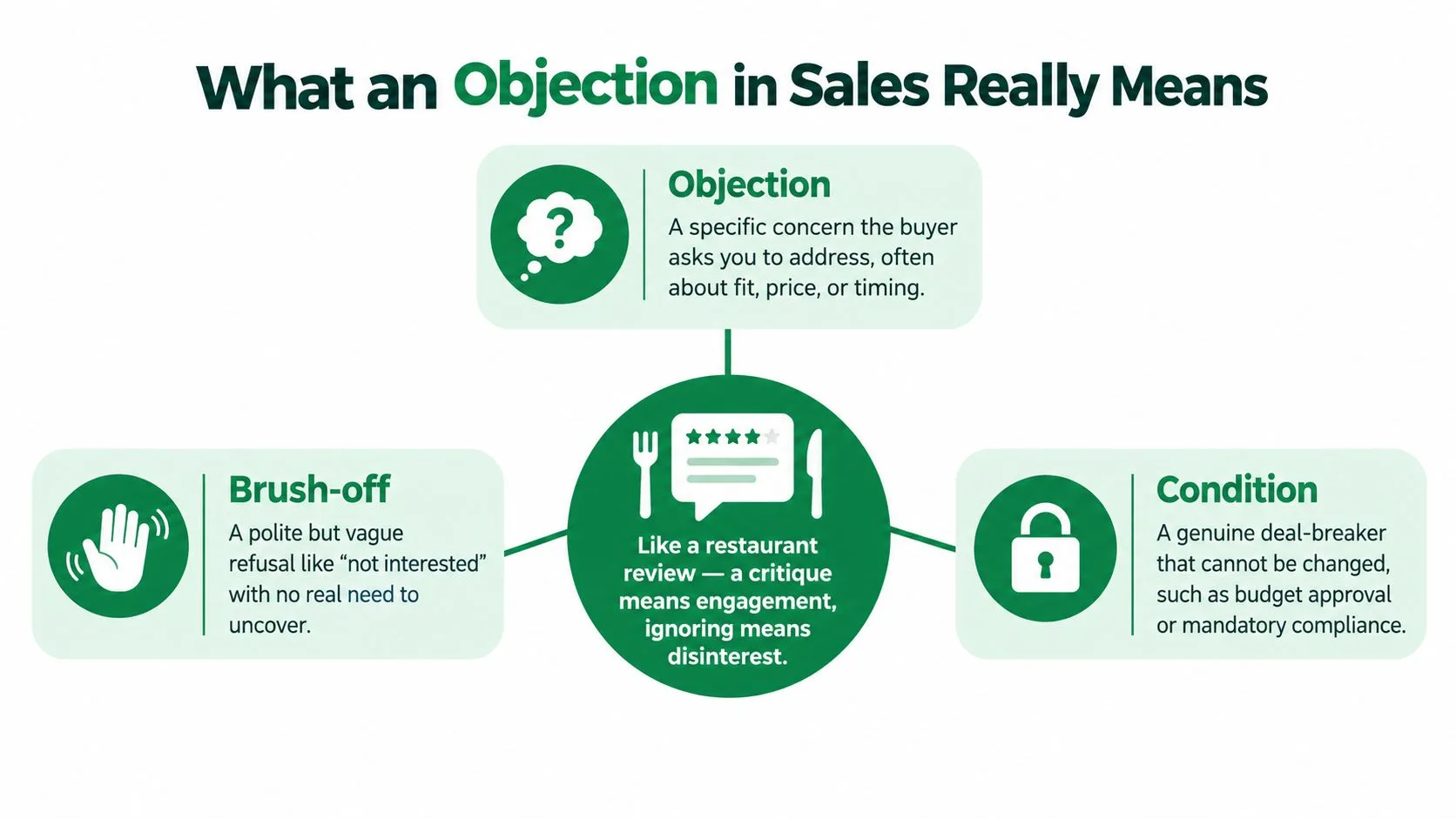
Objection versus brush-off versus condition
A useful way to sort them is to separate signal from noise.
An objection is a signal. The buyer is reacting to something specific enough to discuss. That usually means there is at least some engagement.
A brush-off is weak signal or no signal yet. “Not interested” or “Email me” may be real disinterest, or it may be a fast way to end a conversation before the buyer has decided whether to engage.
A condition is a constraint. It is not a feeling to talk through. It is a real requirement that has to be met, such as procurement rules, a missing budget line, or a compliance review.
The restaurant comparison helps here.
“The food was too salty” works like an objection. It names a specific problem.
“No thanks” at the door works like a brush-off. There is not enough detail yet.
“We have an allergy the kitchen cannot accommodate” works like a condition. The issue is structural.
In sales terms:
- Objection: a concern about value, fit, price, timing, risk, or process
- Brush-off: a vague dismissal such as “not interested” or “send me an email”
- Condition: a real blocker such as missing budget approval or a compliance requirement
Why this distinction matters
The label changes the response.
If it is a brush-off, your job is to test whether any real concern exists underneath it. If it is an objection, your job is to diagnose the friction behind the words. If it is a condition, your job is to confirm whether the deal can realistically move.
That is why skilled reps do not treat the first sentence as the full truth. They treat it as an opening clue.
What an objection is actually signaling
A real objection usually means one of three things is getting in the buyer’s way:
-
They do not see enough value yet
The problem may not feel urgent, specific, or expensive enough to solve. -
They see value, but risk still feels too high
The concern may be change effort, proof, timing, internal politics, or fear of making a bad call. -
They want to buy, but the path is blocked
Approval steps, stakeholders, procurement, budget timing, or technical requirements are slowing the decision.
This is why an objection should be read as diagnostic information, not personal rejection. It narrows the field. “Too expensive” is not a final answer by itself. It could point to weak value perception, low priority, missing authority, or a safer competitor.
How to tell surface resistance from real resistance
Activity signals help.
If a buyer says “send me details,” then repeatedly opens the email in Gmail and revisits the message, that behavior suggests visibility is not the main problem. They saw it. The friction is more likely evaluation, priority, or internal consensus. If the email is never opened, the problem may be much simpler. Your message did not get attention, or it reached the wrong moment or person.
Open signals do not prove intent. They do help you avoid the wrong diagnosis.
That matters because poor objection handling often starts too early. A rep hears a phrase and jumps to an answer. A better rep classifies the type first, then responds to the buying friction underneath it.
A clear objection is useful. It gives you something to diagnose, instead of forcing you to guess at silence.
Scripts often fail for this reason. They answer the phrase. Effective reps answer the cause.
Why Buyers Raise Objections in the First Place
Most objections don’t come from hostility. They come from caution.
Buying something new creates work. It creates uncertainty. It can also create political risk inside the buyer’s company. If the choice goes badly, someone has to explain why they approved it. That’s why even interested buyers can sound resistant.
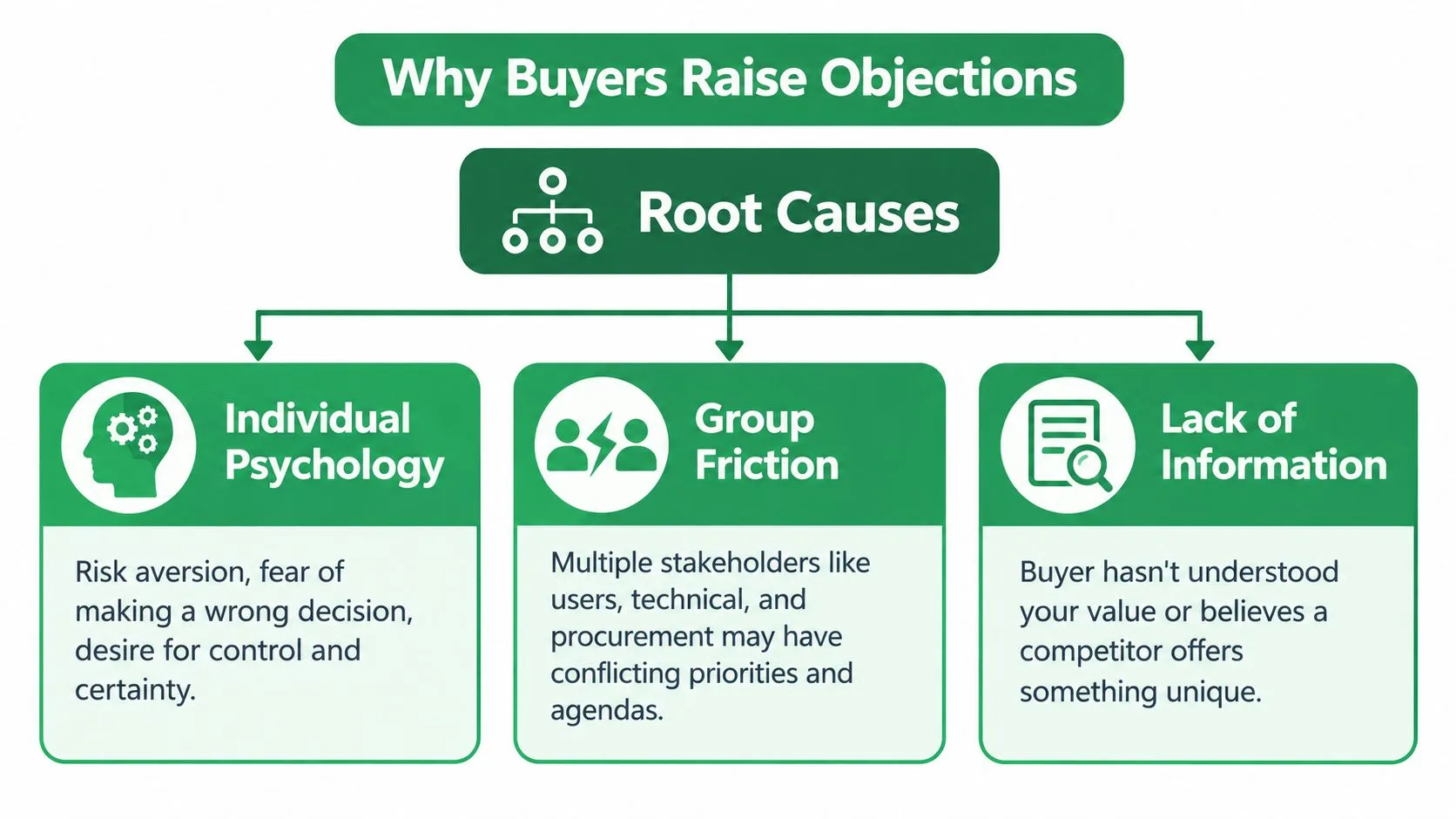
Individual psychology shows up as caution
A buyer may say price is the issue when the issue is fear of making a wrong decision.
They may say timing is bad when they haven’t yet decided whether the change is worth the internal effort. They may ask for more information when they’re really asking for reassurance.
This is one reason objections should be handled gently. Sales guidance grounded in call analysis recommends acknowledge, clarify, and respond with evidence rather than immediate rebuttal, because arguing too early increases friction and reduces disclosure of the blocker. The same industry analysis reports that reps who successfully defend their product against objections can reach close rates as high as 64%, as summarized by SalesHive’s objection handling guidance.
Buying groups create friction you can’t hear at first
Modern B2B buying is rarely one person making a simple yes or no decision.
A Gartner-referenced finding cited by Apollo says 61% of B2B buyers prefer a rep-free buying experience, and another Gartner report says 74% of B2B buying teams show unhealthy conflict during decisions. Buyer groups that reached consensus were 2.5x more likely to rate the purchase as high-quality, according to Apollo’s discussion of handling objections in sales.
That changes how you read objections. “We need to think about it” might mean legal hasn’t weighed in. “This seems expensive” might mean finance sees cost while the user team sees value. “Can you send details?” might mean your contact wants to socialize the idea internally without committing.
Lack of information still matters
Not every objection is political or emotional. Sometimes the buyer just doesn’t understand the difference between your offer and the status quo.
A short diagnostic checklist helps:
- Personal uncertainty: One person sounds hesitant, asks about risk, and avoids committing to next steps.
- Group misalignment: Your contact mentions others, needs to “run it by the team,” or struggles to define decision criteria.
- Information gap: The buyer can describe the problem but can’t yet connect your solution to their context.
Coach’s note: If you answer a consensus problem with more persuasion, you usually create more pressure and less progress.
That’s why the best objection handling starts with interpretation, not defense.
The Five Most Common Types of Sales Objections
A rep hears, “This is too expensive,” and assumes the deal is slipping.
Sometimes it is. Sometimes it is only the buyer’s way of testing whether the value is clear enough to keep talking.
That is why objection handling gets easier when you sort the objection before you answer it. Objections are less like stop signs and more like dashboard lights. The light tells you where to look. It does not tell you the engine is dead.
Most objections fall into five categories: price or budget, need or fit, timing, authority or alignment, and trust or risk. Those labels matter because the same sentence can point to different buying friction depending on context.
As noted earlier, these few categories cover a large share of what reps hear. The useful takeaway is simple. You do not need a clever reply for every sentence. You need a clear read on the type of friction in front of you.
Five Core Sales Objection Types at a Glance
| Objection Type | What Buyer Says | Underlying Friction |
|---|---|---|
| Price or Budget | “Too expensive” | They do not see enough value, do not have budget room, or fear wasting money |
| Need or Fit | “We don’t need this” | The problem is not painful enough yet, or your relevance is unclear |
| Timing | “Not right now” | The change does not beat current priorities or trigger events |
| Authority or Alignment | “I need to check with the team” | Decision power is shared or internal consensus is weak |
| Trust or Risk | “How do I know this will work?” | They need proof, certainty, or confidence in implementation |
How to interpret the underlying signal
Start with where the objection shows up.
Early-stage price pushback often means the buyer is still measuring relevance. They are asking, “Is this worth my attention?” Late-stage price pushback often points somewhere else, such as procurement pressure, weak internal support, or concern about rollout risk.
Timing objections confuse many reps for the same reason. “Not now” can sound like rejection when it is sequencing. A buyer may need a budget window, leadership approval, a contract renewal date, or a team change before they can act.
Authority objections also hide in plain sight. “Let me run this by the team” may mean your contact agrees with you but cannot carry the decision alone. In that case, persuasion aimed at one person will stall because the friction sits inside the buying group.
For teams building outbound process, coaching by objection type works better than memorizing one-off rebuttals. If you manage SDR workflows or want to hire cold callers, train reps to identify the category first, then choose the response that fits the friction.
What Gmail open behavior can tell you
Email adds a clue that calls usually do not give you.
If a prospect never opens your message, the problem may be visibility. Your subject line may miss, your email may arrive at the wrong moment, or the contact may be the wrong person.
If they open the same thread several times and still do not reply, that often points to resistance with some interest attached. They saw it. They came back to it. Something is unresolved.
That pattern helps you classify the objection more accurately. No opens suggests an attention problem. Repeated opens with silence suggest hesitation around fit, timing, risk, or internal alignment. A generic follow-up usually misses that distinction. A better follow-up answers the likely friction directly.
A Simple Framework for Responding to Any Objection
The cleanest response pattern is simple: pause, acknowledge, clarify, respond, confirm.
It works because it lowers tension. Buyers are more likely to tell you the truth when they don’t feel cornered. Reps are more effective when they don’t react defensively.
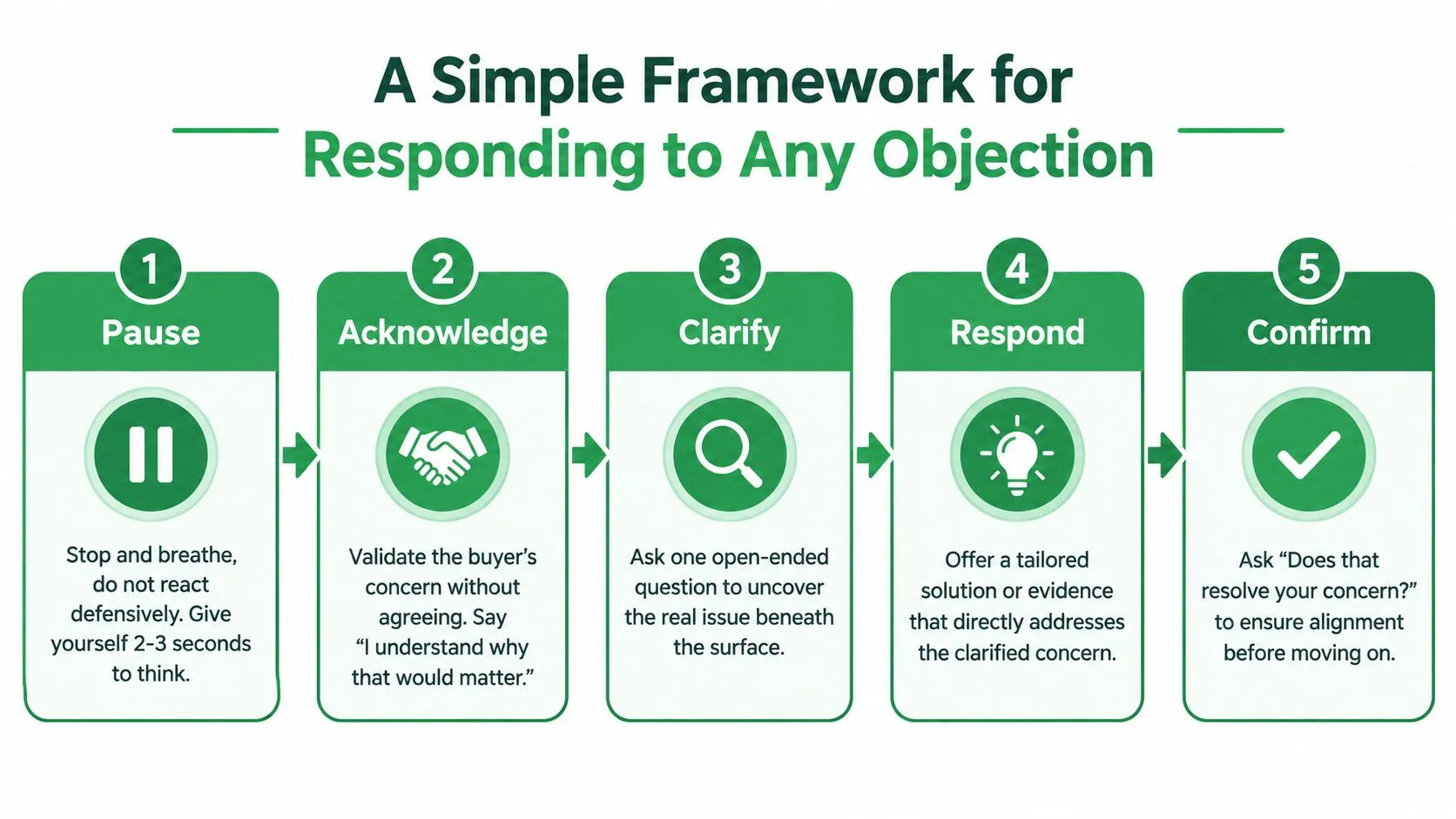
Step one and two slow the moment down
Pause. Don’t jump in.
A short beat keeps you from arguing with the buyer’s first sentence. It also signals confidence.
Acknowledge. Show that the concern makes sense.
You’re not agreeing that the objection is fatal. You’re showing respect for the concern.
Examples:
- On price: “That makes sense. Budget scrutiny is real.”
- On timing: “I understand why this might not feel urgent today.”
- On trust: “That’s a fair question. You’d want proof before changing anything.”
If you want a helpful way to think about pushback as feedback rather than attack, this short Knowledge Nugget mindset on criticism is useful for resetting your posture in tough conversations.
Step three finds the actual blocker
Clarify with one question.
Not three questions. Not an interrogation. One clean question that separates the label from the cause.
Try prompts like these:
- For price: “When you say expensive, are you comparing it to current spend or to the effort of changing?”
- For timing: “What would need to happen internally for this to become a priority?”
- For authority: “Who else would need to be comfortable before you could move forward?”
- For fit: “What feels missing based on what you’ve seen so far?”
If you need better prompts for opening these conversations earlier, this guide to discovery sales questions gives useful ways to uncover friction before it hardens into objections.
Key takeaway: Clarifying questions reduce buyer cognitive load because they narrow the issue to one decision, not ten vague concerns.
Step four and five move the deal forward
Respond with evidence that matches the objection type.
That evidence can be a relevant customer story, implementation detail, workflow explanation, or business comparison. Keep it narrow. Don’t dump your whole deck into the conversation.
Confirm by checking whether that specific concern is resolved.
Simple lines work well:
- “Does that address the concern about rollout effort?”
- “Is budget the main blocker, or is there still a question about fit?”
- “Would that make it easier to bring this to the team?”
A lot of reps skip this last part. They answer, then keep talking. Confirmation tells you whether you solved the right problem.
Real World Examples of Handling Objections Effectively
Examples make this easier than theory. Here’s what the difference looks like in practice.

Price objection on a call
Buyer: “Your pricing is too high.”
Weak response: “We’re very competitive, and our features justify the cost.”
Better response:
- Diagnosis: Price or budget, but value may be the issue
- Clarify: “When you say too high, do you mean it’s outside this quarter’s budget, or that the return still isn’t clear?”
- Respond: “If it’s the second one, I can show you where teams usually see the operational gain so you can compare that against current cost.”
- Confirm: “Would that help you evaluate whether the spend makes sense?”
The point isn’t the wording. It’s the sequence.
Timing objection in Gmail
A prospect opens your email more than once and still doesn’t reply. Many reps send a generic nudge. That usually adds noise.
A better follow-up names the likely friction.
Generic follow-up: “Just checking in on this.”
Category-matched follow-up:
“Looks like this may be more about timing than relevance. If this isn’t a priority until another project wraps or budget reopens, I’m happy to align to that. What event would make this worth revisiting?”
That style works well when you’re using open signals to separate silence from resistance. This guide on follow-up email after no response gives more examples of how to write that kind of message.
Authority objection from a stakeholder
Buyer: “I need to run this by leadership.”
Weak response: “Can we get them on a call?”
Better response:
- Diagnosis: Authority or alignment
- Clarify: “Of course. What do they usually care about most in decisions like this?”
- Respond: “If it helps, I can send a short summary framed around those criteria so you’re not carrying the whole case alone.”
- Confirm: “Would that make the internal conversation easier?”
You’re helping them build consensus, not pressuring them to shortcut process.
A similar mindset shows up in customer support de-escalation. This piece on AgentStack de-escalation techniques is useful because the same principle applies: lower defensiveness first, then solve the issue.
Here’s a short video that reinforces the practical side of objection handling:
Trust objection late in the cycle
Buyer: “We’ve been burned before.”
That sentence isn’t asking for more enthusiasm. It’s asking for safety.
Try this:
- Diagnosis: Trust or risk
- Clarify: “Was the problem poor implementation, weak results, or lack of support after purchase?”
- Respond: “Got it. Then the most relevant thing for us to discuss is how onboarding works and what support looks like after launch.”
- Confirm: “If that part feels solid, would you be comfortable continuing?”
Buyers rarely want a perfect promise. They want confidence that you understand the risk they’re trying to avoid.
Turning Objections Into Progress and Next Steps
The simplest way to improve objection handling is to stop asking, “What should I say?” and start asking, “What kind of friction is this?”
That one change clears up a lot. It keeps you from arguing with brush-offs, overselling into uncertainty, or treating internal misalignment like a persuasion problem.
A practical checklist for daily outreach
Use this on your next call or email thread:
- Name the category: Is this about price, fit, timing, authority, or trust?
- Test the surface statement: Ask one question that separates the label from the cause.
- Match the evidence: Give proof that fits the specific concern, not a generic pitch.
- Read the timing: Early objections can help qualify real opportunities. Late objections often point to structural deal risk.
- Use engagement signals wisely: If emails are seen but ignored, answer the likely obstacle instead of sending another check-in.
- Confirm movement: End with a question that tells you whether the issue is resolved.
What to practice first
Start with the objections you hear most often.
That’s not just a coaching cliché. It’s efficient. Analysis of 300 million cold calls found that 49.5% of objections were dismissive brush-offs, 42.6% were situational concerns, and only 7.9% were tied to an existing solution. The same dataset suggests the top five objection categories account for 74% of all objections, according to Prospeo’s B2B sales objection handling analysis.
In other words, a small set of prepared responses can cover most of the resistance your team hears.
If you want to connect objection handling to the final stage of the conversation, these closing techniques for sales are a good next step because they help you tell the difference between a concern that can be resolved and a deal that isn’t ready to close.
You don’t need sharper rebuttals. You need cleaner diagnosis, calmer delivery, and better follow-up timing.
If you sell from Gmail, Mail Tracker for Gmail gives you read receipts, open counts, timestamps, and real-time notifications directly inside Gmail. That helps you tell the difference between an unseen message and a seen message with unresolved resistance, so your next follow-up can address the actual objection instead of guessing.
Ready to track your emails?
Add Mail Track for Gmail from the Google Workspace Marketplace and know the moment your emails are opened. Free and unlimited.
Add to GmailMore reading
More from Tutorials
How to Find My Contacts in Gmail: A Practical Guide
Learn how to find my contacts in Gmail on desktop and mobile. Clear steps for Google Contacts, search tips, shortcuts, and contact details from emails.
How to Forward Emails in Gmail
Learn how to forward emails in Gmail with step-by-step instructions for single messages, automated filters, mobile setups, and troubleshooting silent failures.

How to Check Read Receipts in Gmail
Learn how to check read receipts in Gmail on web and mobile. Covers native options, add-on tracking, icon meanings, and fixes for common issues.